| category |
| ||||
| #1 | (A) | DARK MATTER IN A FLUID UNIVERSE 1st Edition | |||
| #2 | (B) | DARK MATTER IN A FLUID UNIVERSE 2nd Edition SUMMARY | |||
| #3 | n/a | DARK MATTER IN A FLUID UNIVERSE 2nd Edition | |||
| #4 | (B) | BIRTH OF A HURRICANE | |||
| #5 | (B) | ON SEISMOLOGY | |||
| #6 | (B) | ON SIGNIFICANT NUMBERS | |||
| #7 | (n/a | ||||
| #8 | (n/a) |
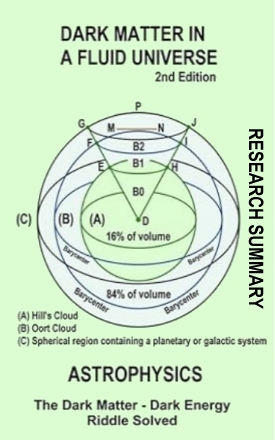 |
(link to book on Amazon) ~20 page summary Dark Matter in a Fluid Universe 2nd Edition Summary Dark Matter in a Fluid Universe 2nd Edition is an alternative proposal as to how galaxies and planetary systems are formed. The book cover image is that of both a developing protoplanetary system as well as a developing galaxy. The inner 54% of the radius (16% of the mass) of a developing system is defined / repurposed as the Hill's Cloud. The outer 46% of the radius (84% of the mass) is defined / repurposed as the Oort Cloud, promoting evidence mass contained in the Oort Cloud never migrates inward, that all of the mass contributing to the formation of the Sun and planets originates from within the Hill's Cloud. The author then asks, which approach defining the formation of galaxies and planetary systems do you think is more plausible? Scientists state they have no idea what Dark Matter / Dark Energy are comprised of or where they're located. Dark Matter in a Fluid Universe claims to provide the answer. The 1st Edition of Dark Matter in a Fluid Universe applied a 5% visible mass / 95% invisible mass ratio for Dark Matter / Dark Energy claims. The 2nd Edition of Dark Matter in a Fluid Universe removes Dark Energy as a factor, applying 16% visible mass (Hill's Cloud) / 84% invisible mass (Oort Cloud) for its analysis. |